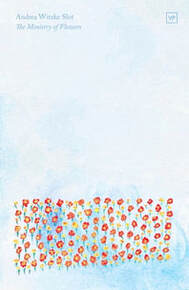
The Ministry of Flowers
Valley Press, 2020
Purchase a copy through
The Poetry Book Society, Amazon UK, Amazon US
If you'd like a signed copy (with a hand-painted bookmark),
I'd be happy to send one your way. Just email me at the link above.
The latest review by Phill Provance is in the American Book Review (University of Nebraska Press), Fall 2022, now available at Project Muse.
What does it mean to be human in an uncaring world? For me, one answer has come in the form of Andrea Witzke Slot’s latest collection, The Ministry of Flowers, which evinces an awareness singularly apt for our times. It is, however, not a collection intent upon pat answers, reciprocating the world’s mysteries with mystery in kind. In other words, it is a book that achieves the difficult ends of inspiring childlike wonderment in adults by reintroducing us to the world—as if, for want of a more recent analogy, her speakers are the characters of Lewis Padgett’s classic short story “Mimsy Were the Borogoves,” attempting to teach us how to rethink our common reality in non-Euclidian terms. Thus, Slot refreshes our perspective, showing us newly discovered aspects of our surroundings we previously failed to notice, and consequently conveying a hint of salvation through her work. [ ... ] it is Slot’s questioning and the communion and communication it intrinsically implies that strikes me as the most vital, pertinent, and affirming reason to suggest her collection to ABR’s readers; it is the exact mechanism because of which the collection has risen above all others as the most prescient in its composition, timely in its release, and consequential in its effect of the many I’ve read this year. - Phill Provance
Valley Press, 2020
Purchase a copy through
The Poetry Book Society, Amazon UK, Amazon US
If you'd like a signed copy (with a hand-painted bookmark),
I'd be happy to send one your way. Just email me at the link above.
The latest review by Phill Provance is in the American Book Review (University of Nebraska Press), Fall 2022, now available at Project Muse.
What does it mean to be human in an uncaring world? For me, one answer has come in the form of Andrea Witzke Slot’s latest collection, The Ministry of Flowers, which evinces an awareness singularly apt for our times. It is, however, not a collection intent upon pat answers, reciprocating the world’s mysteries with mystery in kind. In other words, it is a book that achieves the difficult ends of inspiring childlike wonderment in adults by reintroducing us to the world—as if, for want of a more recent analogy, her speakers are the characters of Lewis Padgett’s classic short story “Mimsy Were the Borogoves,” attempting to teach us how to rethink our common reality in non-Euclidian terms. Thus, Slot refreshes our perspective, showing us newly discovered aspects of our surroundings we previously failed to notice, and consequently conveying a hint of salvation through her work. [ ... ] it is Slot’s questioning and the communion and communication it intrinsically implies that strikes me as the most vital, pertinent, and affirming reason to suggest her collection to ABR’s readers; it is the exact mechanism because of which the collection has risen above all others as the most prescient in its composition, timely in its release, and consequential in its effect of the many I’ve read this year. - Phill Provance
Incredibly grateful to Jordi Alonso and Erin Elizabeth Smith for featuring poems from the book at Sundress Publications Best Dressed blog: Gemütlichkeit, Memory is not a Peacock landing on a sleeve, An Autobiography called Skin, Book Burning and Qumran
and for the generous, thoughtful, intelligent reviews by Linda Nemec Foster's at Presence: a journal of Catholic Poetry, Emma Storr's at London Grip and Susannah Lang's at Rhino Reviews and Goodreads.
Writing is such a mystery, maybe especially to writers themselves,
and I continue to learn and discover so much about my own work with every new review.
|
~ ~ ~
A truly compelling and original work, The Ministry of Flowers intimately weaves cultural concerns with family drama and questions of personal identity and societal gender expectations into a dream-like tapestry that’s as sharp-edged as it is gorgeously rendered. Slot’s visceral collection smolders with heartache, gritty natural landscapes, and an insistent lyrical beauty that both celebrates and haunts the edges of our familiar world. Here, even smiles are ‘scar-lined’. Here, ‘Goodbye / frames our lives’. These poems are packed with metaphors and feelings that made my heart fall into my stomach and my mind spin with creative delight. At its core, The Ministry of Flowers is a profound ‘way of / saying, I am here, and here I will remain’.
John Sibley Williams, author of As One Fire Consumes Another, winner of the Orison Poetry Prize and the University of Nebraska Press's Backwaters Prize, The Laux/Millar Prize, The Wabash Prize, and the Philip Booth Award, |
~ ~ ~
One might predict from this book’s gentle title that the contents would be a tidy garden, small in thoughts. But like the Dickinson whose line inspired it, this book is a forest, a wild meadow, and the centering astonishment too of a singular open bloom. I’d begun to think that no poetry could reach me this year. I have had a little fence around me. These poems – their deft form, extraordinary titles – are so intimate in their griefs and passions, exhaustions, tendernesses, so distinctly womanist, that I am, gratefully, shaken. - Valerie Wallace, author of House of McQueen, winner of Four Way Press’s First Book Prize
~ ~ ~
Andrea Witzke Slot writes intelligent well crafted poems...her strength lies in her keen observation and strong feelings for the natural world. Marge Piercy, author On the Way Out, Turn Off the Lights,
|
|
~ ~ ~
The striking title of Andrea Witzke Slot’s collection, Ministry of Flowers, captures what her poems do best, in merging the political with the emotional – in other words, to express what it is to be human in our difficult times. She is a compassionate recorder of moments and lives that have remained vivid in memory, of our fallible bodies, broken hearts and enduring loves. Her project in this beautiful book, to paraphrase one of her statements, is to locate a kinder world out of a place ‘where chaos meets chance’. - Tamar Yoseloff, author of, most recently, The Black Place (Seren)
|
~ ~ ~
The Ministry of Flowers invokes Emily Dickinson as it imagines a world in which ministry and
caregiving are a form of exchange between nations, people, and all living creatures. These lyric poems exquisitely recall the urgency and passion of youth while showing the reader how to age gracefully and find both ‘new fire’ and ‘time to rail’. Slot notices, pays keen attention to, and captures the small moments and ‘muddled compost’ of everyday life. This collection holds out its hand with ‘forget-me-not blues, all hues / of hyacinth tolls and gentian dues’ in a heartfelt appeal for kindness that opened my mind and heart to the beauty of this rough world. - Deborah Hauser, author of Ennui: From the Diagnostic and Statistical Field Guide of Feminine Disorders (Finishing Line Press) |
|
|
|
|
~ ~ ~
What I cherish most about the poems in The Ministry of Flowers is how open-hearted and welcoming they are, how they both celebrate and foster the beauty and necessity of human kindness, connection, and courage. Andrea Witzke Slot is a deeply generous poet, and her work invites us to look with more loving, more forgiving eyes at ourselves and others, and at life and death, even in times of great struggle and loss, with an air of gratitude, reverence, and surprise. In one poem, the speaker says to Emily Dickinson, her muse and imagined sister, ‘Please open your door. I have changed’. The Ministry of Flowers opens this door, then invites us in, so we too can be transformed and renewed as we bear witness to ‘the unrehearsed choreography of astonishment’. - Faisal Mohyuddin, author of The Displaced Children of Displaced Children, a Poetry Book Society Recommendation and winner of Eyewear’s Sexton Prize
|
~ ~ ~
Andrea Witzke Slot’s The Ministry of Flowers is quiet and composed, full of grief and yearning for what we must leave behind. This longing, however, is not without hope. And though hope is “the thing with feathers,” Slot turns us to another of Emily Dickinson’s poems as we navigate motherhood, illness, love, and how time grips each. The name of the collection grew from a Dickinson poem, which also serves as part of the book’s epigraph: Between My Country—and the Others— There is a Sea— But Flowers—negotiate between us— As Ministry. Slot, herself a transplant to the U.K. from the United States of her birth, is no stranger to the Seas and Countries that negotiate between speaker and reader, but it is, instead, the flowers she offers us in her gift of these poems. - Chelsea Krieg, poet, educator and journalist https://www.chelseakrieg.com
|
|
~ ~ ~
‘How hard can it be to stand on sand?’ the poet asks. How transient things are—nothing stays the same, entropy bound to underpin everything and every one of us is in danger of becoming another ‘unrehearsed vanishing act’. And yet—that very attrition, that very transience—is celebrated in these poignant hymns to the transformative nature of life’s experiences, fleeting as those experiences may be. Love, touch, the gift of family, even the breaking down of relationships and the body - everything in the end, is to be valued. An uplifting, intelligent and immensely engaging exploration of our fragility. To be treasured. - Vanessa Gebbie, author of The Coward’s Tale (Bloomsbury)
|
~ ~ ~
The Ministry of Flowers is a collection of odes and elegies, meditations and provocations that sing from the page and invite you to travel through the body as landscape, to journey on boats made from beds and to praise llamas, ants and oaks as emblems of struggle and change. Andrea Witzke Slot has an ear for the lullaby, the love-song and the manifesto and an eye that alights on a daring juxtaposition of images caught in the flashlight of her close observation and courageous imagination. Love is a swarm of bees, time zones are alchemy, and truck stops are places for prayer and wisdom. The long breath of prose poems is punctuated with compact tercets, couplets, a sonnet and one or two concrete poems - a wide range of form humming with a sure and enquiring voice. This is a collection to dive into, sure in the knowledge that you will be rewarded with startling images, tender narratives and a thought-provoking vision that will resonate long after you have turned the last page. - Fiona Bennett, founder of the Poetry Exchange, British Podcast Silver Award Winner
|
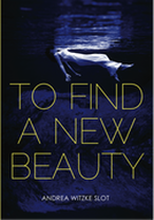
To find a new beauty
Gold Wake Press, 2012 is now out of stock by copies can still be found at Amazon UK, Amazon US. Email if you would like to purchase one directly from me. |
"A refreshingly well-read debut from a talented poet." - Kristina Marie Darling. Read the full review at LitPub here. |
|
~ ~ ~
"How have you been haunted? TO FIND A NEW BEAUTY, Andrea Witzke Slot's first book of poems enumerates the many ways that elegy, witnessing, and the dead haunt the living. With elegies that at once celebrate the dead and long for their touch, TO FIND A NEW BEAUTY is interested in just that—finding a beauty in the refuse, in what is left, in the hulking remains of grief. Quite simply, the moan of the dead haunts the reader. Through an intense intimacy, Slot's poems touch the reader 'like a ghost whose white dress whispers over the sheets of your bed.' Be prepared to be touched."--Roger Reeves, author of King Me
~ ~ ~
"Slot's work stands equal with that of Snyder and Oliver. With bewitching language, she pulls the reader into a gentle current of rolling imagery. Suspended within the flow of these pages, I was carried to a place of calm reflection."— L. M. Browning, a TEDx speaker and the award-winning author of twelve titles. |
~ ~ ~
"Andrea Witzke Slot's TO FIND A NEW BEAUTY is rich with cool, intelligent and carefully crafted poems that often have a subtext of terror and darkness. She uses a variety of personae—Penelope, Eurydice, Io, the nymph on Keats's Grecian urn, a woman who marries her sister's widower and others—in land- [and sea-] scapes that are powerful personae too in these poems."— Marge Piercy, author of 17 novels including The New York Times Bestseller Gone To Soldiers, the National Bestsellers Braided Lives and The Longing of Women, the classics Woman on the Edge of Time and He, She and It, and most recently Sex Wars. Among her 20 volumes of poetry the most recently published is On the Way Out, Turn off the Light.
~ ~ ~
"In the background of Andrea Witzke Slot's TO FIND A NEW BEAUTY glimmers the controlling metaphor of the Biblical garden; in the foreground is the body's desire, longing that reveals itself in tensions that roil between origin and some possible, almost imaginable, end point.... The speaker's restless eye keeps catching upon images from the landscape that suggest to her what alternative garden might still be created by human hands. What lay between Alpha and Omega are transience, uncertainty and shifting tides. This is a volume of poetry, then, celebrating animation, celebrating pilgrimage not so much in its common religious or secular senses, but rather in a qualified archetypal sense; that is, these poems trace the human quest to recover the sacred via the potential transformative powers inherent in human agency."— John Hoppenthaler
|
Work is also included in the academic anthologies:
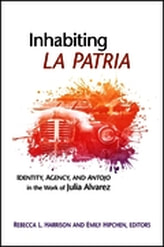
Inhabiting "La Patria": Identity, Agency, and "Antojo" in the Work of Julia Alvarez
SUNY Press, 2013 “'Between the Scylla and the Charybdis': Remapping Subjectivity in the Dialogic Waters of Julia Alvarez’s 'The Other Side/El Otro Lado,'” by Andrea Witzke Slot illustrates how the social fabric of dialogic interaction in Alvarez's long poem is driven by the intense subjectivity and structural/contextual power of the poetic form. By circling the power structures of speech and social class structures, Alavarez's poem not only gives voices to those who are without voice but, more importantly, awakens readers to the thought patterns that often invisibly limit ourselves and others. Drawing on theories by Chela Sandoval, Gloria Anzaldúa, and Homi Bhabha, the essay demonstrates Alvarez uses the “in-between” of cultures, classes, and languages to create insurgent emancipatory weaponry in her complex, multi-voiced work. Read through PROJECT MUSE or buy the book here: |
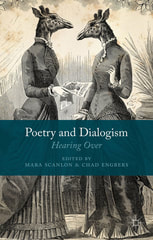
Dialogism and Poetry: Hearing Over
Palgrave Macmillan, 2014 "Dialogic Poetry as Emancipatory Technology: Ventriloquy and Voiceovers in the Rhythmic Junctures of Harryette Mullen’s Muse & Drudge" by Andrea Witzke Slot explores the complex movement of subjectivity in Mullen's work through the act of ventriloquy. By demonstrating how this play on voice--as it occupies numerous ideological positions--the essay who's how the poetic form can break down and break through the subtle forms of subjugation that continue to infiltrate social relationships and thought. Read the essay HERE OR buy the book here: |